Warrawee Cottage, Halls Gap, The Grampians
Oooooh! It is cold. Boy, am I glad to be holding this steaming cup of tea. It is just dawn outside and it looks like a lovely day from my window-side seat. Here I am, comfortably nestled in a cushioned armchair sipping good tea and thinking about the nice time we had yesterday and wondering what the day holds in store for us today.
There are six of us. With two Ford Falcons, both boots full of stuff and a cheer in our hearts we had set off from our apartments in St. Kilda, Melbourne last morning. That was Saturday, the sixteenth of April 2005. After taking a couple of wrong turns and finally managing to get back on track we followed the Western Freeway to Ballarat, the gold-mining town of yesteryear and on past it, through Ararat and to Halls Gap.
Halls Gap is a small township sitting on the entrance to the Grampians. The Grampians is a dense natural forest area with a lot of mountains and wildlife. Halls Gap sits in a small Gap between Mountains forming a gateway to the spectacular scenery of the Grampians. I wouldn’t call it even a township, for it is just a congregation of a few buildings. There is the Visitor’s Information Centre, a grocery cum utility shop, a bottle shop and a police station. A Petrol station and a cricket oval provide a finishing touch to the town. There is a nice park with a few swings and slides for kids and serves as an ideal spot for a picnic lunch.
At the visitor’s centre we were helped by a nice lady. We picked up enough local knowledge and decide where we wanted to go. We collected maps with driving directions. Our first and most pressing need was however to find suitable accommodation for the night for the six of us. We had not bothered to book ahead, knowing this time of the year is not tourist season yet. We came expecting a few rooms at a motel or a Bed and Breakfast establishment and I am understating our surprise and joy in saying that we were overwhelmed when the kind lady at the visitor’s centre asked us if we wished to rent a lovely cottage all for ourselves. The price was good and we jumped at the chance.
So here we came to Warrawee, an orange painted wooden cottage with a first floor a long drive and garden. A neat porch leading to the front door and a barbecue grill by the back. Inside, the cottage is an epitome of homeliness and comfort. A tastefully set up living room and fully equipped kitchen, nice bath and toilet facilities and service area, two Queen Bedrooms and a third bedroom with single cots, make up the house. A nice balcony in the first floor looking out in the elevation is a nice touch of class.
So here we set down our stuff and set out to explore some of the attractions of the Grampians.
The Boroka Lookout and the Ried Lookout are very nice spots on the edges of the cliffs overlooking spectacular scenery. The lovely blue of the distant lakes and the rising mountains with vales in-between lend a refreshing feeling of goodness and beauty. The one snapshot that would stay in my memory for a while is the soft blue of Lake Wartook lying snugly between two arms of the Grampian Ranges. I might have a picture here of it to share with you.

Lake Wartook from Boroka Lookout
Our hearts light and fluttering, having taking in these spectacular sights, we carried on towards the Mac Kenzie Falls. The Mac Kenzie Falls is reputed to be Australia’s highest waterfall, though in reality it is not too high; I would put it at something between 60 and 70 metres tall. There is a narrow and quite treacherous track leading to the bottom of the falls where the water collects in a wide pool in dark rock. The track starts of rugged and rocky and slowly the gradient increases until it becomes very steep and very narrow. To make things even more tricky, the lower you descend, the more wet and slippery the rock underfoot becomes, not to mention the thick roots of the cliff hanging flora trying to trip you every step of the way. The brave and careful who overcome these hazards are treated to a spectacle like none other. The vista opens up a gorgeous and raucous waterfall that gets smothered into a placid pool set amidst a rocky cul-de-sac. I fell in love with this idyllic setting and will cherish this visit for a long long time.

MacKenzie Falls
On our way back (after pulling ourselves up the same way we went down, becoming quite weary in the process I might add) we stopped by at the small kiosk a the head of the track. The jolly kiosk-tender supplied us with tea, coffee, ice-creams and biscuits at a reasonable cost. I even picked up a nice small (real) boomerang from his shop window. We had had a great time so far in our trip, but there was one small detail missing. It feels quite awkward to concede the point but the fact remained that I had not seen a single kangaroo in Australia yet in my two months of stay here! I lamented my tale of woe in the passing to the kiosk-tender and voila, I hit pay dirt almost immediately! The garrulous shop-keeper told me that I was standing in the middle of Kangaroo land. He showed us a spot on our way back home that he reckoned would be the best place to see a really large number of kangaroos. This spot turned out to be the Cricket Oval in Halls gap! It was getting on dusk and the air was cool, perfect for the kangaroos to come out for a graze and what better grazing ground than a lush green cricket oval!
I saw a few dozen Kangaroos in the Oval. We stopped our cars and let all our travel fatigue ebb away strolling in the midst of these mild-mannered and quiet marsupials. This was probably the best finish to the day I could have hoped for. After a while (several photos and hopping matches later), we began to feel the chill of the night and headed away to Warrawee Cottage. A couple of loaves of bread, some butter, jam and hot cups of milk later, I tucked myself into the cozy bed and let my eyelids droop off leaving my mind wandering the green fields with the kangaroos of Halls Gap.
The sun is up now and I am eagerly looking forward to today’s adventures in the hypnotic Grampians.
Until my next blog, au revoir!
There are six of us. With two Ford Falcons, both boots full of stuff and a cheer in our hearts we had set off from our apartments in St. Kilda, Melbourne last morning. That was Saturday, the sixteenth of April 2005. After taking a couple of wrong turns and finally managing to get back on track we followed the Western Freeway to Ballarat, the gold-mining town of yesteryear and on past it, through Ararat and to Halls Gap.
Halls Gap is a small township sitting on the entrance to the Grampians. The Grampians is a dense natural forest area with a lot of mountains and wildlife. Halls Gap sits in a small Gap between Mountains forming a gateway to the spectacular scenery of the Grampians. I wouldn’t call it even a township, for it is just a congregation of a few buildings. There is the Visitor’s Information Centre, a grocery cum utility shop, a bottle shop and a police station. A Petrol station and a cricket oval provide a finishing touch to the town. There is a nice park with a few swings and slides for kids and serves as an ideal spot for a picnic lunch.
At the visitor’s centre we were helped by a nice lady. We picked up enough local knowledge and decide where we wanted to go. We collected maps with driving directions. Our first and most pressing need was however to find suitable accommodation for the night for the six of us. We had not bothered to book ahead, knowing this time of the year is not tourist season yet. We came expecting a few rooms at a motel or a Bed and Breakfast establishment and I am understating our surprise and joy in saying that we were overwhelmed when the kind lady at the visitor’s centre asked us if we wished to rent a lovely cottage all for ourselves. The price was good and we jumped at the chance.
So here we came to Warrawee, an orange painted wooden cottage with a first floor a long drive and garden. A neat porch leading to the front door and a barbecue grill by the back. Inside, the cottage is an epitome of homeliness and comfort. A tastefully set up living room and fully equipped kitchen, nice bath and toilet facilities and service area, two Queen Bedrooms and a third bedroom with single cots, make up the house. A nice balcony in the first floor looking out in the elevation is a nice touch of class.
So here we set down our stuff and set out to explore some of the attractions of the Grampians.
The Boroka Lookout and the Ried Lookout are very nice spots on the edges of the cliffs overlooking spectacular scenery. The lovely blue of the distant lakes and the rising mountains with vales in-between lend a refreshing feeling of goodness and beauty. The one snapshot that would stay in my memory for a while is the soft blue of Lake Wartook lying snugly between two arms of the Grampian Ranges. I might have a picture here of it to share with you.

Lake Wartook from Boroka Lookout
Our hearts light and fluttering, having taking in these spectacular sights, we carried on towards the Mac Kenzie Falls. The Mac Kenzie Falls is reputed to be Australia’s highest waterfall, though in reality it is not too high; I would put it at something between 60 and 70 metres tall. There is a narrow and quite treacherous track leading to the bottom of the falls where the water collects in a wide pool in dark rock. The track starts of rugged and rocky and slowly the gradient increases until it becomes very steep and very narrow. To make things even more tricky, the lower you descend, the more wet and slippery the rock underfoot becomes, not to mention the thick roots of the cliff hanging flora trying to trip you every step of the way. The brave and careful who overcome these hazards are treated to a spectacle like none other. The vista opens up a gorgeous and raucous waterfall that gets smothered into a placid pool set amidst a rocky cul-de-sac. I fell in love with this idyllic setting and will cherish this visit for a long long time.
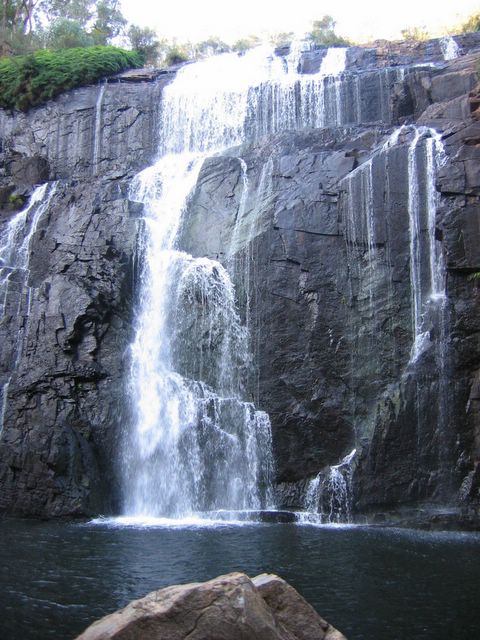
MacKenzie Falls
On our way back (after pulling ourselves up the same way we went down, becoming quite weary in the process I might add) we stopped by at the small kiosk a the head of the track. The jolly kiosk-tender supplied us with tea, coffee, ice-creams and biscuits at a reasonable cost. I even picked up a nice small (real) boomerang from his shop window. We had had a great time so far in our trip, but there was one small detail missing. It feels quite awkward to concede the point but the fact remained that I had not seen a single kangaroo in Australia yet in my two months of stay here! I lamented my tale of woe in the passing to the kiosk-tender and voila, I hit pay dirt almost immediately! The garrulous shop-keeper told me that I was standing in the middle of Kangaroo land. He showed us a spot on our way back home that he reckoned would be the best place to see a really large number of kangaroos. This spot turned out to be the Cricket Oval in Halls gap! It was getting on dusk and the air was cool, perfect for the kangaroos to come out for a graze and what better grazing ground than a lush green cricket oval!
I saw a few dozen Kangaroos in the Oval. We stopped our cars and let all our travel fatigue ebb away strolling in the midst of these mild-mannered and quiet marsupials. This was probably the best finish to the day I could have hoped for. After a while (several photos and hopping matches later), we began to feel the chill of the night and headed away to Warrawee Cottage. A couple of loaves of bread, some butter, jam and hot cups of milk later, I tucked myself into the cozy bed and let my eyelids droop off leaving my mind wandering the green fields with the kangaroos of Halls Gap.
The sun is up now and I am eagerly looking forward to today’s adventures in the hypnotic Grampians.
Until my next blog, au revoir!